

The Fame Reporter interviewed multi-talented Australian performers, Caity Plummer, Ellen Ebbs and Freya Boltman. The incredible thespians are all currently starring as three of the five daughters Chava, Hodel and Tzeitel respectively, in the iconic classic ‘Fiddler on the Roof’ playing at QPAC’s new Glasshouse Theatre in Brisbane until 25 October on its successful Australian tour, heading to Melbourne and Perth thereafter.
We caught up with the talented performers Caity Plummer, Ellen Ebbs and Freya Boltman, who are currently starring as Chava, Hodel and Tzeitel respectively in the iconic musical Fiddler on the Roof.
The trio chatted about bringing their characters to life, building an offstage sisterhood, exploring the show’s Jewish traditions and enduring themes, and what it’s like performing in QPAC’s stunning Glasshouse Theatre in Brisbane.
Tzeitel, Hodel and Chava are three of Tevye’s five daughters, and each has a distinct personality and outlook on life. If you had to introduce your character to someone who has never seen Fiddler on the Roof, how would you describe her?
Freya: Tzeitel is a textbook eldest daughter. She is intelligent, empathetic, practical and a true trail-blazer. While Tzeitel follows the most ‘traditional’ path of the sisters, she is extremely brave, being the first to challenge Anatevka’s matchmaking traditions.
Caity: I would describe Chava as bookish, cheerful, introverted and inquisitive- and perhaps the most misunderstood of the daughters. I believe she is a symbol of progression. She is curious about the world around her.
Ellen: I would describe Hodel as someone who is strong-minded, witty and isn’t afraid to go against the grain. I alike her to strong female literary characters such as Jo March or Sybylla Melvyn.
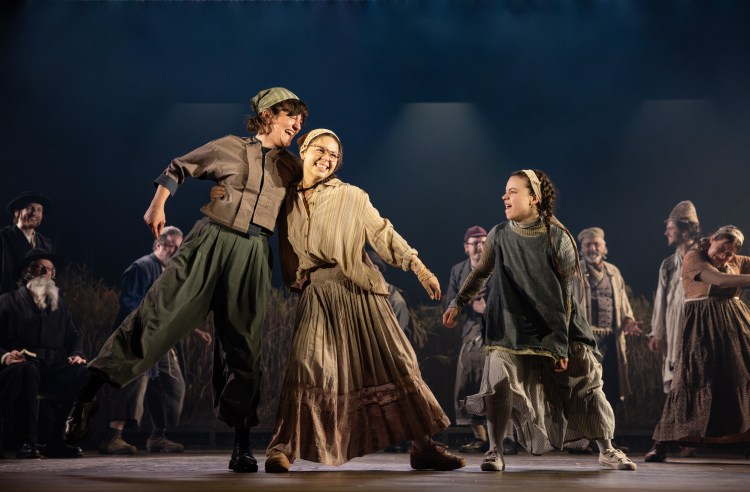
The three sisters each make important decisions about love and their futures, often challenging the expectations placed on them. Which aspect of your character’s journey has been the most interesting or challenging to explore?
F: In the second act, Tzeitel and her new husband Motel welcome two new arrivals – a sewing machine and a baby! It’s been really interesting to explore her transition into motherhood during a very turbulent time for the community.
C: I think it makes Chava’s fate all the more devastating as Tzeitel now understands the usually unbreakable bond between parent and child.
The most interesting thing to explore has been the huge juxtaposition between Chava in Act 1 and Act 2. In the first act, I see Chava as a happy-go-lucky girl who is still learning about the world through her reading and through her sisters, and who is yet to make any formal decisions for herself.
The lyrics that Tevye and Golde later sing in ‘Chavaleh’ are a repeated mantra for me throughout the first act. “Little bird, happy little thing, gentle, kind, affectionate”.
Then Act 2 is a total tonal shift. Chava is suddenly navigating her morals, her love, her family and her faith- all at once. It has been fascinating to explore that transformation.
E: The most challenging aspect of Hodel’s journey has been her reckoning with her traditional values versus her love for Perchik. Hodel is someone who has always found a lot of comfort in her family life and thought she had life all figured out in Anatevka.
This all gets flipped upside down when she meets Perchik, as he enlightens her to a world outside of her small community.
I find it so interesting and heartbreaking that ultimately she chooses Perchik over her family; I think she even surprises herself with this decision.
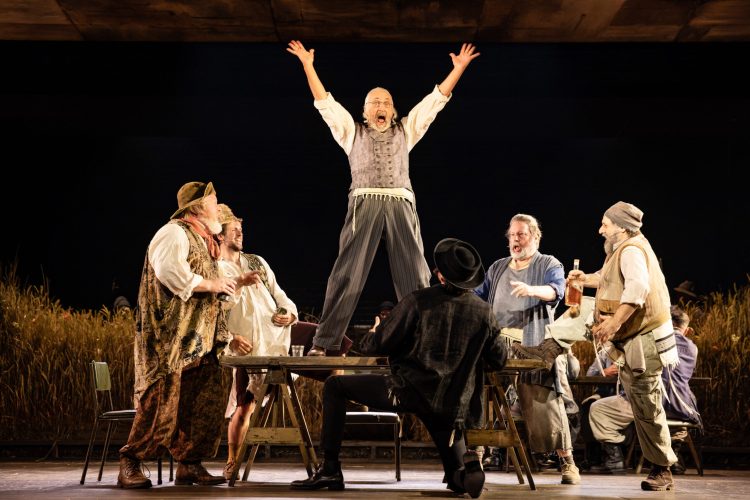
With five daughters in the family, there’s plenty of personality under one roof! What has been the most fun part of developing the relationship between your three characters, and have you developed any offstage sisterly rituals of your own?
F: We were so lucky that we immediately found our groove as sisters and best friends.
During rehearsals, I loved working on Matchmaker and the scene preceding it as we found our unique familial rhythm that sisters often share. I love the twenty-five minutes from the half hour call to beginners in our dressing room.
Getting ready together feels very sacred, I feel like I’m sixteen again getting ready for a party! – Freya
E: Working alongside Caity and Freya has been an absolute honour.
We were very lucky that we all formed a bond quite early on in rehearsals and this really gave us the license to play and challenge each other – having 2 older sisters in real life, I GET IT!
A sister ritual that we have is every night right before ‘matchmaker’ we hug each other in a little huddle, take a breath together and then set a word for that particular performance.
Some recent examples have been ‘play’, ‘fun’, ‘punk’ or ‘let’s rock today’ (from School of Rock obvi). – Ellen
C: In real life, I’m the eldest of three, with two younger brothers, so stepping into this production and playing the middle of five sisters has been a fresh joy.
I have so much love for my show sisters. The specific bond between Freya, Ellen and I has been really special.
We genuinely work together like sisters- there’s an unspoken understanding of each other, both on and off stage. What a rare gift that is. – Caity
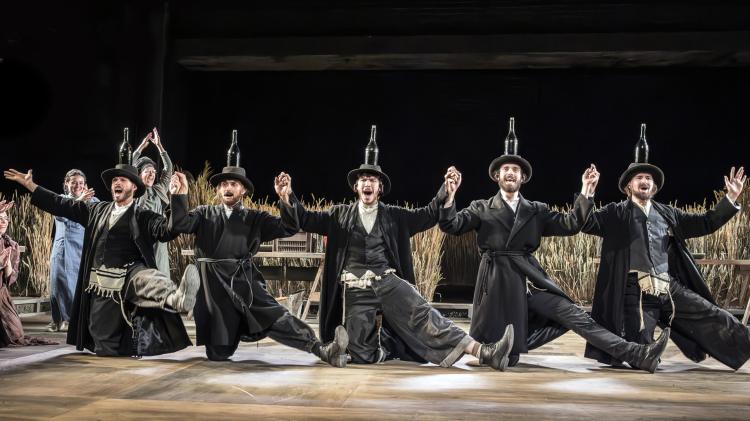
Jewish faith, culture and tradition are central to Fiddler on the Roof. What has preparing for this production taught you about the Jewish traditions and community at the heart of the story, and how have you approached bringing those elements to the stage with authenticity and respect?
F: I grew up in a big Jewish family and community, not too dissimilar to the folks of Anatevka.
My family came to Australia as refugees during and post World War II so the story and traditions were already very close to me. Each night during the song Anatevka, I connect with my ancestors who faced the same fate as my character Tzeitel.
We have been directed to look up and see Anatevka, so I imagine my ancestors staring back at me, passing on the strength and bravery they possessed only eighty years ago.
It is the greatest honour being able to represent my Jewish family’s story every night, I can only describe it as an almost spiritual experience – Freya
E: Coming into this production as a non-Jewish performer, I did an extensive amount of personal preparation and research on Jewish traditions and history and was also so excited to learn from fellow cast mates and creatives.
The main aspect of Jewish religion that I have learnt is the focus on living in the present.
This idea of ‘living in the now’ is powerfully embodied in the show’s song ‘To life’! I learnt that this is famously sung at many Jewish celebrations!
This notion of being present is also beautifully reflected in the Jewish tradition of ‘shabbat’ which we do every Friday night as a company before the show. – Ellen
It is such a beautiful time to come together and honour the Jewish tradition.
We were very lucky to have Rabbi Ninio as a cultural consultant on the show so we could ask her all of our questions regarding traditions we perform on stage to make sure we are performing the show with the integrity and respect it deserves.
C: The Fiddler on the Roof company has been extraordinary in its approach to the Jewish faith and to the specific story we are retelling. It has been an incredibly delicate, thoughtful and considered process.
Shabbat- the notion of pausing, reflecting and coming together is something that has constantly been applied both on and off stage within our company. It’s been a beautiful way to approach this story and the community at its heart.
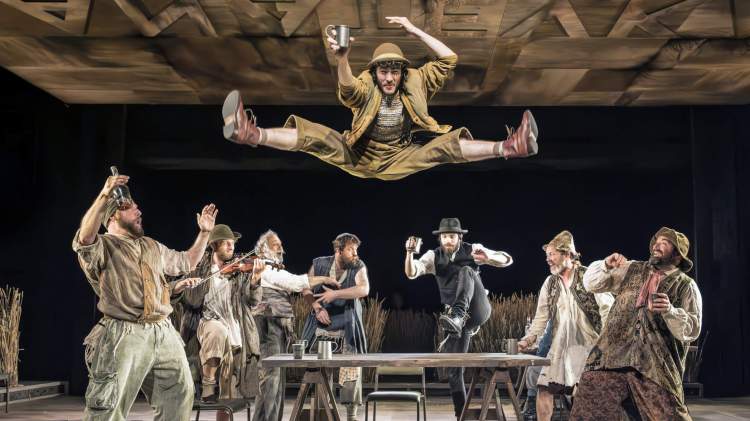
The story was first performed decades ago, yet its themes of family expectations, generational differences and forging your own path still resonate today. What do you think makes this story so enduring, particularly for younger audiences?
F: My late grandmother would proudly remind me that Fiddler on the Roof is extremely popular in Japan and I think that encapsulates how universal and enduring the story is.
Whether you’re from a Jewish, Japanese or Colombian family, everyone has had to subvert their family’s expectations of them, particularly if you’re part of an immigrant community.
I think young women watching the show will see the daughters fighting for their own independence and have both an appreciation for how far we’ve come but also how things aren’t entirely different in 2026.
The piece is inherently feminist, despite Tevye’s line “I am the man of the house” it is really Golde and the girls who dictate family life and the sisters’ futures. – Freya
E: I think what makes this story so enduring is the writing. The book is razor sharp and witty and I think it’s the humour that makes it so accessible to a younger audience.
The main themes of family expectations and generational differences are such universal themes.
I think especially for young women that see this show, they feel very seen watching three strong and intelligent daughters being assertive and standing up for themselves against the patriarchal expectations placed upon them. – Ellen
It is an ugly truth that even in 2026, we are still standing up to patriarchal ideals and sexist notions such as the ‘manosphere’.
But, it is through live theatre such as Fiddler that presents such strong female leads who are made to be more than ‘wives’ or ‘daughters’ that leaves the audience questioning deeply rooted values that uphold our society.
C: Honestly, I believe the show centre’s itself around love- and love of all kinds.
Love for your family, your neighbours, your partner, your work, love in a rebellious sense, love for the land you live on… the list goes on.
At its heart, Fiddler is asking us what we are willing to risk for the people and things we love, and I think that question will always resonate. – Caity
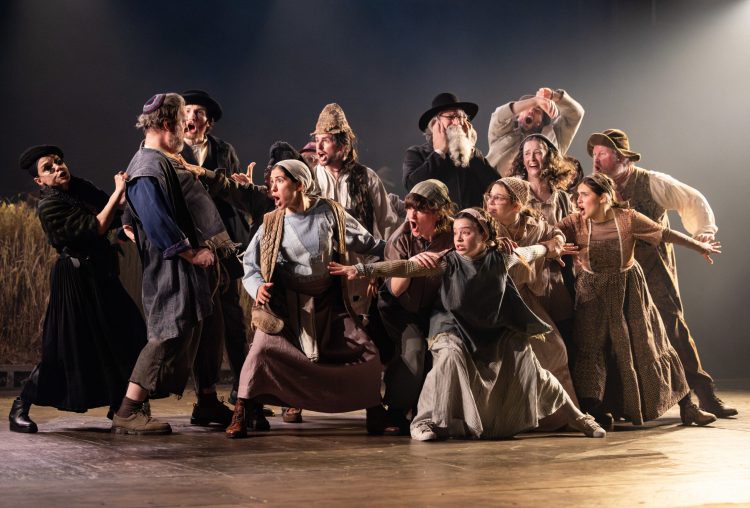
Freya and Caity, you both trained at the Victorian College of the Arts, while Ellen trained at WAAPA. How did your training shape you as performers, and what have you learned from working professionally that you couldn’t have learned in a classroom?
F: My training at the VCA gave me so many different tools as a performer, but overall it shaped me to be as versatile as possible. I came into the course with a specific set of skills and I left with an almost shape-shifting ability to tackle a diverse range of material.
Working professionally is (as I expected) completely different to the classroom. I think it has fostered a greater sense of self-reliance and belief.
There are so many people and elements that go into a commercial musical and you’re only a small piece of the puzzle.
Therefore you have to be really clued into your own performance, maintaining what the director has set as well as trying to improve every show without a teacher grading you.
E: I absolutely loved my time at WAAPA. I moved to Perth from Sydney fresh out of high school and not knowing anyone so I think my training really taught me how to be an adaptable performer.
Under the direction of fantastic mentors, I learnt that it is my job to be malleable and playful; to not let my ego get in the way of a piece of direction and to simply ‘TTFN’ = take the f’king note!
Since working professionally, the thing I have learnt that I couldn’t learn at drama school was sustaining 8 shows a week. At drama school, your season is never longer than a week – which is just previews in the professional world!
We are at 82 shows (the longest I have ever done a show) and I have learnt SO MUCH about sustainability and pacing.
C: What I adored about my time at VCA was its strong focus on acting, which I feel shaped me more than anything. No matter what we were learning- whether analysing a phrase of piano accompaniment or kicking a leg- it always came back to intention and motivation.
We studied some incredible texts and really threw ourselves into the deep end. I absolutely loved it.
Still to this day, lessons from my brilliant teachers continue to resonate as I grow older. This revival of Fiddler is an actor’s playground, and I really do feel that what I learnt at VCA has supported me throughout this production.
As for what I’ve learnt on the job, it’s a little more simple: listen. Listen to those who have walked the path before you. Listen to your scene partner. Listen to your body. Listen to your instrument. Listen! – Caity
Caity, this production marks your principal debut as Chava. What has it been like stepping into such a significant role, and is there a particular moment in the show that has made the experience especially memorable for you?
It has been the biggest blessing. I couldn’t have picked a better show to work on for 2026. It has been so creatively fulfilling. I feel beautifully exhausted- what an honour.
Without a doubt, the clarinet is one of the most memorable parts of the experience for me. I grew up playing the clarinet from the age of eight through to my final high school exams.
My father is a music teacher and instilled that love of music in me growing up. – Caity
As much as it was just a school hobby at the time, I could never have predicted that I would not touch the instrument for eleven years, before picking it up again for this production.
Funny how the world works. It’s a real gift to play every night.
What an honour to share a principal debut with Freya and Ellen as well. We are all making our main-stage principal debuts together. – Caity
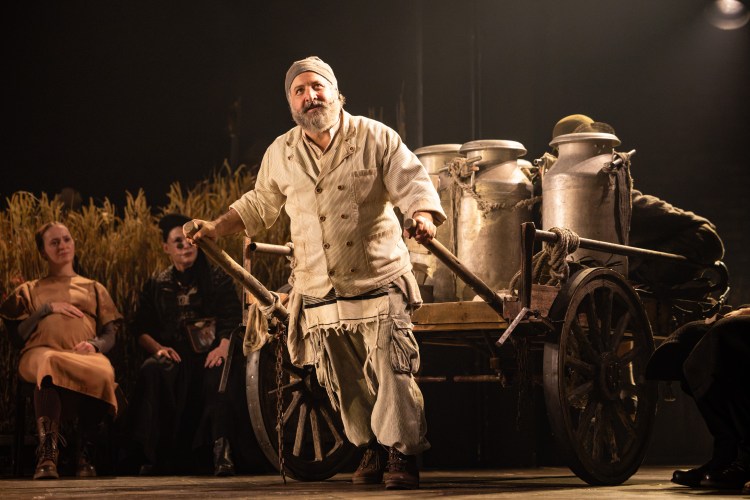
The score of Fiddler on the Roof is filled with iconic songs, from joyful celebrations to deeply emotional moments. Is there a number that has taken on a new meaning for you since working on the production?
F: Growing up with the score of Fiddler, I always had my favourite numbers and Sabbath Prayer was not one of them!
Since working on Fiddler, Sabbath Prayer has become one of the most meaningful and beautiful moments of the show for me.
I have an action-packed track so I use the prayer to ground myself and take stock of our beautiful show family. During the song, I also send love and protective energy to our wonderful audiences.
E: The song that has taken on a whole new meaning for me since working on this production is ‘Matchmaker’.
I have heard this song so many times in my life and always imagine the three daughters singing sweetly, swishing their skirts and holding their brooms.
Very quickly into rehearsals, I realised that this was not going to be the case in this production. Jordan Fein has directed ‘matchmaker’ to be this punk, feminist anthem.
Fein’s direction mixed with Julia Cheng’s punchy choreo and Mark Aspinall’s new orchestrations, really bring out the heartbreaking lyrics of this song – like “playing with matches a girl can get burned” – and highlight the daughters’ rude awakening of what it means to be a woman.
C: My heart lives in the score of Fiddler. I could listen to ‘Tradition’ on repeat- particularly the original film version. But the song that has taken on a completely new meaning for me has to be ‘Chavaleh’.
The piece has always been a ballet, but the way Jordan Fein and Mark Aspinall have worked together to reimagine the number has been magical.
It begins as a familiar tune, but the musical extension opens up this much bigger conversation around tradition versus progression. It feels like Chava’s entire world is contained within that piece.
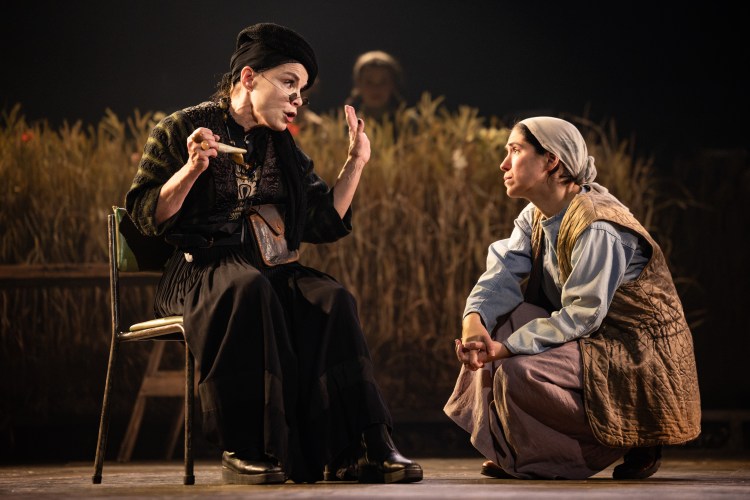
You’re performing in Brisbane’s Glasshouse Theatre at QPAC. What has it been like bringing this classic musical to this venue, and what do you hope audiences leave the theatre thinking or feeling?
F: I am a huge fan of the Glasshouse Theatre!!! The acoustics are through the roof, I love the green hue of the seats and the dressing rooms genuinely resemble a hotel room!
I feel so lucky to be one of the first productions to perform in this stunning venue.
I hope audiences find a new appreciation for Jewish culture and a deep motivation to fight for displaced communities all over the world. – Freya
E: It is an absolute pleasure bringing Fiddler to the Glasshouse.
This is my Brisbane debut and my first time being at QPAC and I am absolutely in love with this venue! Not only is the Glasshouse stunning but the SOUND is next level. – Ellen
I will never forget the first time we all sang “Tradition” as a company and I actually thought we might blow the roof off; it was like a rock concert, it was awesome!
The Brisbane audiences have also been an absolute treat! I hope audiences leave the theatre feeling moved and leave thinking about the enduring nature of community and family. – Ellen
C: What a stunning new theatre to perform in. Our company is absolutely loving it. I hope audiences leave the theatre feeling emotionally fulfilled.
I hope they’ve had a good laugh, I hope they’re moved, and I hope they’ve learnt something. Fiddler is one of those rare gems that can do all of those things at once. – Caity
If you could each give your character one piece of advice before the events of the musical begin, what would you tell her?
F: Anything is possible with a butcher’s knife, a white sheet and a couple of smoke machines!
E: Trust your gut.
C: Stay curious.

The Fame Reporter Quick-Fire
Which of the five daughters would you most want as your housemate?
F: Bielke
C: Hodel
E: Chava – Cause we could read together and make our own book club!
Matchmaking or following your heart?
C: Following and leading from the heart.
F: Following your heart, always ❤
E: Following your heart (to Siberia)
Who is most likely to make the others laugh at the worst possible moment backstage?
F: We’re all hilarious but I think Sigrid or Dani Barnes take the cake!
E: Bielke (Ksenia)
C: Felix (Motel) tests me every show- so funny.
If you could swap roles with anyone in the cast for one performance, who would you choose?
F: Mendel – he has the best one-liners.
E: Motel! I would love to ride his bike + Miracles is one of my favourite songs in the show!
C: Fruma Sarah… Sorry Freya, I am coming for your gig…. It is ICONIC!
Which tune is your current karaoke song?
F: The House of the Rising Sun – Dolly Parton version!!
E: It’s hard out here for a b*tch – Lily Allen
C: Tequila by The Champs.
Who would be the best at keeping a secret, and who would accidentally spill the tea?
F: Chava can definitely keep a secret. Shprintze and Bielke are spilling the tea!
E: Chava could keep a secret. Tzeitel would probs tell Mama.
C: Hodel would keep the secret. Tzeitel, I agree, would tell Mama
If you could invite three people, living or dead, to a Shabbat dinner, who would be on your guest list?
F: Bette Midler, Diana Ross and Cole Escola.
E: Stephen Sondheim. Liza Minelli. Phoebe Waller-Bridge.
C: Judy Garland, Sammy Davis Jr, Ruthie Henshall.
Describe each of your fellow actresses in one word
F: Caity is gentle, Ellen is open-hearted
E: Caity = considerate + Freya = enticing
C: Freya= grounded, Ellen= generous.
Which sister would survive best in the modern world, and why?
F: I think Tzeitel would actually have a good crack at it. She is strong-willed and isn’t afraid to ask for what she wants. She would’ve been a front runner of the women’s liberation movement and eventually become a powerful CEO.
E: Not to be Bias BUT defs Hodel because I think she would be pleased to see women are more encouraged to take up space and speak their mind. I think she could be Prime Minister.
C: Hodel. I see modern Hodel’s everywhere.
Finally, who would Tevye worry about the most if all five daughters had a night out together?
F: Hodel … she’s too cheeky for her own good!
E: Either Bielke or Hodel. They are both cheeky and have the party animal inside of them.
C: Bielke purely because she’s the baby… but I also think he’d be worried for Chava. He’d want his reading buddy back home.
Thank-you all for joining us at The Fame Reporter, best of luck with the show.
TICKETS
Fiddler on the Roof The Musical
Glasshouse Theatre – Brisbane
Playing until 25 October
The Fame Reporter Social Media
YouTube
Instagram
Facebook
All photos – Supplied

