
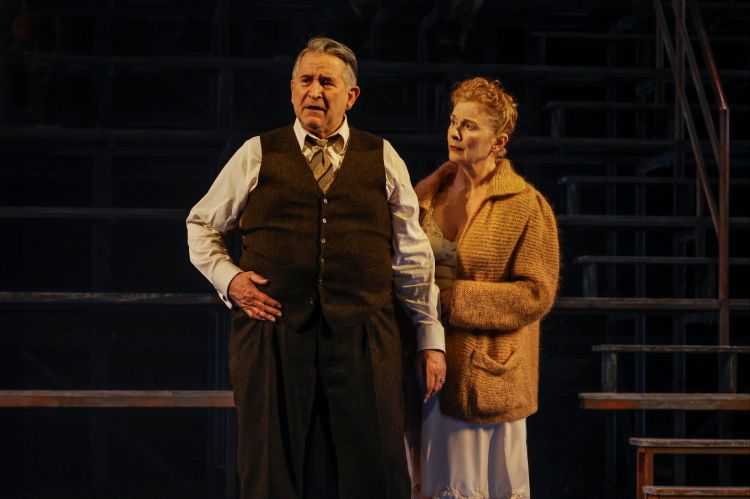
Arthur Miller’s Death of a Salesman arrives at Brisbane’s Lyric Theatre, QPAC in a production that is as physically arresting as it is emotionally devastating. Under the direction of Neil Armfield, Miller’s examination of family, ambition, masculinity and the elusive promise of the American Dream feels immediate, intimate and painfully human.
At the centre of the production is Anthony LaPaglia as Willy Loman, delivering a performance of extraordinary emotional and physical intensity. LaPaglia captures Willy’s fractured state of mind with remarkable precision, shifting between bravado, vulnerability, anger and despair. His Willy is a man desperately attempting to hold together a version of himself that is steadily slipping away.
Alison Whyte brings warmth, dignity and immense emotional strength to Linda Loman. Her performance provides an affecting centre to the production, particularly as Linda’s unwavering devotion to her husband collides with the devastating reality of his decline.
Josh Helman’s Biff is equally compelling. His performance is charged with a restless physicality that communicates Biff’s frustration, disappointment and unresolved anger. The relationship between Biff and Willy becomes one of the production’s most powerful emotional battlegrounds. Ben O’Toole’s Happy provides a fascinating contrast, capturing the character’s charm and confidence while revealing the insecurity and desperate need for approval beneath the surface.
The supporting performances are equally accomplished. Anthony Phelan brings considerable presence to Ben, while Marco Chiappi’s Charley offers humanity and a grounded counterpoint to Willy’s increasingly distorted worldview. Aisha Aidara, Paula Arundell and Elizabeth make strong impressions in their respective roles, while Darcy Brown and the ensemble contribute to the production’s impressive momentum and physical energy.
One of the production’s most striking elements is its physical language. The use of bleachers creates a stark and exposed performance space, with the characters seemingly always on display. The actors move through and around the structure with purpose, transforming the set into an extension of the emotional world of the play.
This physicality becomes particularly effective as the story moves backwards and forwards through time. Memories, fantasies and present-day reality collide seamlessly. The past is not simply remembered; it appears to invade the present. This fractured movement through time gives the audience a powerful insight into Willy’s deteriorating perception of reality and the memories that continue to shape him.
The New York accents also contribute strongly to the authenticity of the production. They feel natural and grounded rather than exaggerated, helping establish a convincing world while allowing the characters’ emotional lives to remain at the forefront.
The staging is striking in its simplicity and scale. The bleachers create both a sense of community and isolation, while the movement of the actors continually reshapes the space. There is a feeling that Willy is trapped within his own memories, surrounded by the people and expectations that have defined his life.
What ultimately makes this production so affecting is the commitment of its performers. The emotional stakes are high, but the performances remain grounded in the humanity of these characters. We see their hopes, failures, resentments, love and desperation without being offered easy answers.
At its heart, Death of a Salesman is not simply a story about failure. It is about the stories we tell ourselves in order to survive — and what happens when those stories can no longer protect us.
Neil Armfield’s production brings those themes vividly to life through powerful performances, impressive physicality and an emotionally charged approach to Miller’s classic text.
Powerful, confronting and deeply moving, Death of a Salesman is a production that stays with you long after the final curtain.
TICKETS
Now playing at Lyric Theatre, QPAC.
All images supplied.

